
Wednesday - July 15, 2026

Fair Guides
At ART MUMBAI, artwork isn’t restricted to gallery walls– it is woven throughout the fair. Each year, the entire ART MUMBAI grounds become the ‘Sculpture Park,’ an open-air outdoor sculpture exhibition, with installations placed throughout the hangars and open spaces. Curated by Veeranganakumari Solanki, the Sculpture Park removes the traditional space that separates art from its viewers, punctuating the fair with opportunities to move through and around art.
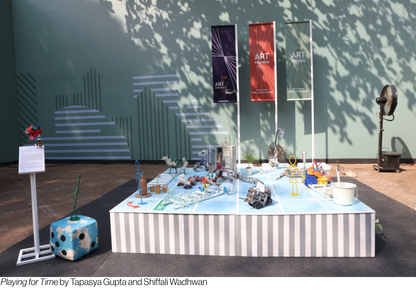
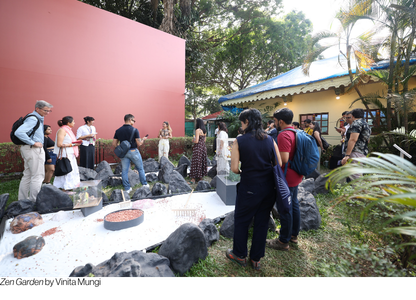
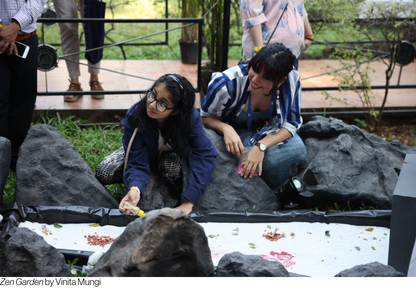
The Sculpture Park – presented in 360 degrees – is designed to allow visitors multiple perspectives instead of a single viewpoint. At ART MUMBAI 2025, some works even invited the audience to play a role in ‘completing’ the piece. Zen Garden by Vinita Mungi, a contemporary Indian sculptor, reimagines the zen garden through a post-colonial lens, as a site of gendered labour and cultural erasure. The artist invited audiences to create their own patterns in the sand of her sculpture, in a feminist act of ritualistic labour, as a resistance to the historical silencing of women. Tapasya Gupta and Shiffali Wadhwan’s Playing for Time recreates a giant ‘Snakes and Ladders’ into an interactive sculpture that explores themes of climate change and environmental erosion. The climate anxiety that the work aims to address can be felt best by engaging with the immersive public art and playing the ‘game’.
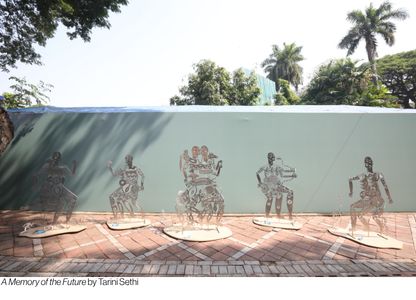
Some sculptures are designed to bring life to—and have life brought to them by—the outside. The air, sky, and light become a key element of their viewing experience. In Tarini Sethi’s A Memory of the Future, a site-specific installation displayed at ART MUMBAI 2025, light and shadow were as much part of the sculpture as the metal figures– and so the fair environment became part of the artwork itself.
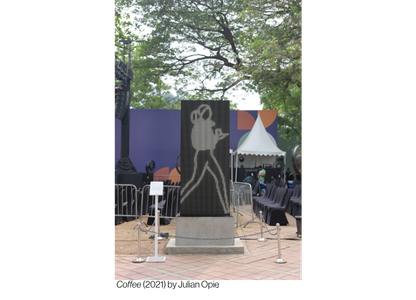
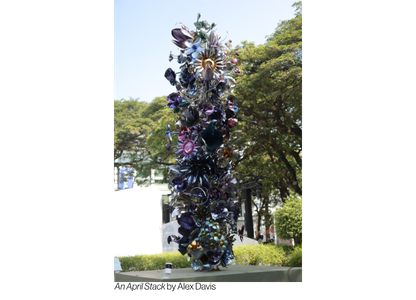
Bombay, too, becomes an integral part of ART MUMBAI’s Sculpture Park. The changing sunlight through the day, surrounding city sounds, and situational landscape all influence how each artwork is perceived. Sensorially, the work and its context make the experience. In 2024, the Sculpture Park directly reflected this influence. An April Stack by Alex Davis, a steel sculptor, is a towering steel column of flowers, symbolic of Mumbai’s ever-soaring sky scrapers, was iridescent in the daylight, and glinted like apartment windows at night. Julian Opie’s Coffee, where a figure walks with a cup of coffee and a phone in her hand, is a visualisation of the breakneck pace of city life.
In 2025, the Sculpture Park championed women artists in contemporary Indian sculpture, who created art in a historically patriarchal tradition. Veeranganakumari Solanki aimed to platform artists across generations, who used a range of materials and spoke to diverse themes. And so, the Sculpture Park became an opportunity to see artwork from South Asian sculptors across time, traditions and the diaspora in one place.
By bringing art into open air and having it interact with elements of the fair, both the Mahalaxmi Racecourse, ART MUMBAI's venue in Mumbai, and fair visitors, the Sculpture Park transforms the fair into a dynamic space. Here, sculpture can be experienced not just as static, complete work, but as something shaped by movement and interaction, of their surroundings and the people around them.